
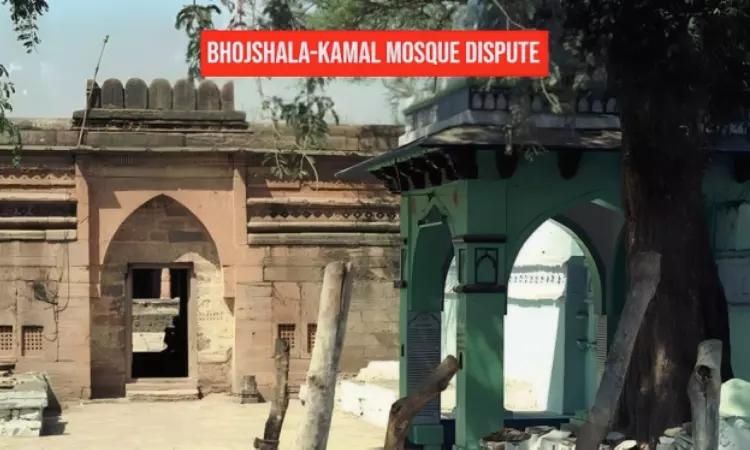
Muslim Side: No Temple Proof, 1935 Namaz Permission Valid in Bhojshala Dispute
In the ongoing Bhojshala Temple-Kamal Maula Mosque dispute, Qazi Zakullah, a petitioner from the Muslim community, argued there is no concrete proof that a temple existed at the site. He cited a 1935 Alaan by the Dhar Ruler permitting Namaz, valid as the monument was not declared protected by the government or ASI between 1904 and 1951. The dispute involves Bhojshala, an 11th-century ASI-protected monument, revered by Hindus as a Vagdevi (Goddess Saraswati) temple and by Muslims as the Kamal Maula Mosque. A 2003 ASI arrangement allows Hindu puja on Tuesdays and Muslim Namaz on Fridays. One PIL seeks a scientific review to reclaim the site for Hindus and prohibit Muslim Namaz.
The High Court ordered a site survey, challenged by the Maulana Kamaluddin Welfare Society. The Supreme Court allowed the survey but directed the High Court to unseal the report, share copies with parties, and consider objections. Senior Advocate Shobha Menon, in her rejoinder, argued petitioners acknowledged disputed facts about the site's original nature, citing WP 10497 of 2022, where they sought carbon dating to determine if it was a temple or learning center. She contended this lack of clarity undermines their claim of an unquestionable right to worship under Article 25. Menon warned granting relief on disputed facts would open floodgates, stating, "if on these disputed facts, if there is going to be a decree, the floodgate will open and civil courts will cease to exist... Therefore, this right of worship, if it is there, is also a civil right."
Menon also addressed the historical legal framework, noting the property was under the Dhar Ruler's authority from 1904 to 1951, with no protection notification under the 1904 Act. She defended the 1935 Alaan's validity, asserting the Ruler's authority. She argued the site's protected status emerged only after the 1951 and 1958 Acts, stating, "It is only for the first time with the virtue of the 1951 Act, a deeming fiction was created under Section 3, which does not mean retrospective application, but only means the application of provisions." On alleged Section 16 violations, she said, "Character is not yet determined, and so how Section 16 was violated. In the present case, the basic facts are disputed."
Senior Advocate Salman Khurshid, for the Maulana Kamaluddin Welfare Society, argued the main relief sought relates to restrictions imposed by the 2003 ASI order, not title declaration. He objected to the 2024 ASI survey, alleging procedural irregularities and questionable methodology, including lack of carbon dating and damage to stairs. Kuldeep Tiwari, one of the...
More High Court Updates News


Enjoying TindPosting?
Get the app for a faster, personalized news experience.
