
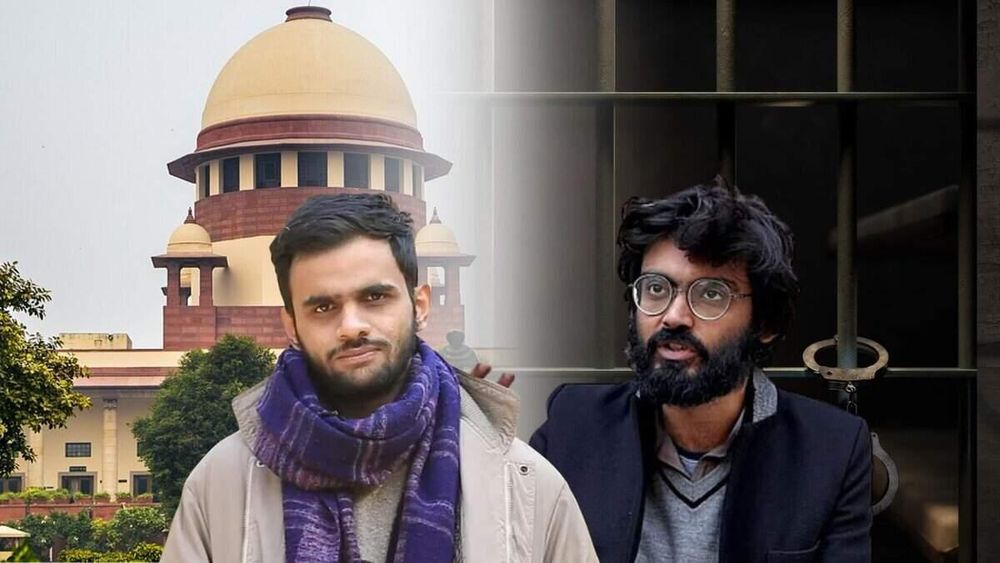
Supreme Court Rebukes Lower Benches, Affirms Bail Rights Under UAPA
The Supreme Court on May 18 strongly criticized a January 2026 ruling that denied bail to activists Umar Khalid and Sharjeel Imam in the Delhi riots conspiracy case. The two-judge bench that decided the case failed to follow a binding three-judge bench precedent on bail under the UAPA.
Justices BV Nagarathna and Ujjal Bhuyan made these observations while granting bail to Syed Iftikhar Andrabi, a Jammu and Kashmir resident held in NIA custody for over six years on terrorism funding charges.
The court specifically targeted the Gulfisha Fatima judgment, which denied bail to Khalid and Imam, and the 2024 Gurwinder Singh judgment. Both had departed from the 2021 three-judge bench ruling in Union of India v. KA Najeeb, which established prolonged pre-trial incarceration as a valid ground for bail even under the stringent UAPA.
Justice Bhuyan stated that a smaller bench cannot dilute, circumvent, or disregard the ratio of a larger bench. The court also struck down the "two-prong test" from Gurwinder Singh, which required the accused to first prove the case lacked prima facie merit before seeking bail.
The bench held that "even under the UAPA, bail is the rule and jail is the exception," emphasizing that Article 21's guarantee of personal liberty applies regardless of charge severity. Both the Gurwinder Singh and Gulfisha Fatima judgments were authored by Justice Aravind Kumar.
More Supreme Court Verdicts News


Enjoying TindPosting?
Get the app for a faster, personalized news experience.
